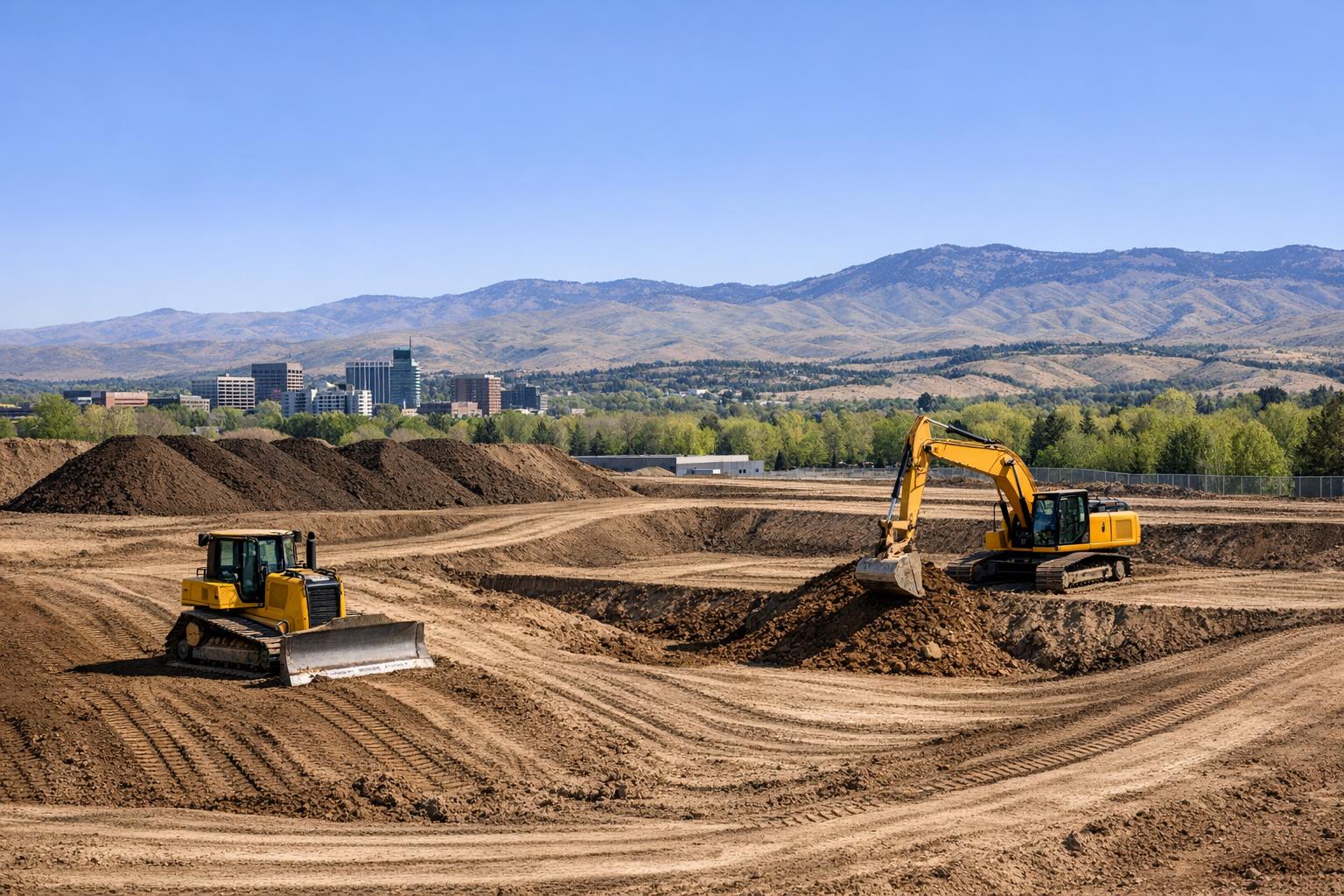
Spring site prep in the Treasure Valley starts with the dirt work done right
Cut and fill is the backbone of efficient lot preparation—especially for rural landowners, builders, and developers trying to keep projects moving while minimizing soil import/export. When grading is planned well, it reduces wet-spot headaches, protects foundations, and helps you avoid rework when utilities and concrete work begin. This guide explains how cut and fill in Boise typically works, what to watch for in Idaho’s seasons and soils, and how to keep your site stable, drainable, and build-ready.
Local note: Boise and the surrounding Treasure Valley can see fast weather swings in spring. A site that looks “dry enough” in the morning can turn into ruts and pumping subgrade after an afternoon shower—especially if you open up too much area at once or drive equipment on wet soils.
What “cut and fill” really means (and why it matters)
Cut is soil removed from higher areas. Fill is soil placed in lower areas to reach the desired grade. The goal isn’t simply to make the lot “flat”—it’s to create the right elevations and slopes for:
• A stable, compacted building pad (home, shop, garage, ADU, or commercial slab)
• Positive drainage that moves water away from structures
• Driveway approaches and access that won’t rut or pond
• Utility corridors that can be trenched safely and restored properly
• Erosion control compliance (especially during wet months or larger disturbances)
Why cut & fill can save money without cutting corners
Budget-focused projects often win or lose on soil handling. Every unnecessary yard of dirt hauled off-site (export) or brought in (import) adds trucking, time, and risk. Smart grading tries to “balance the site,” meaning the amount cut closely matches the amount filled after accounting for compaction and topsoil management.
This is where experience matters: over-strip topsoil, under-compact fill, or misjudge drainage, and the site can settle—showing up later as cracked flatwork, driveway dips, or standing water near the foundation.
Cut & fill “watch-outs” in Boise-area lots
Every property is different, but these issues come up frequently in the Treasure Valley:
• Freeze-thaw durability starts below the concrete. Concrete slabs and driveways in Idaho perform best when the sub-base is properly prepared, drained, and compacted.
• “Looks compact” isn’t compact. Placing fill in thick lifts or compacting when too wet leads to future settlement.
• Topsoil is valuable—but not structural. Topsoil should typically be stripped, stockpiled, and reused for landscaping, not buried under footings or slabs.
• Drainage needs a path. If water has nowhere to go, it will find the lowest point—often the building pad or driveway edge.
• Utility conflicts are common. Existing laterals, irrigation, and older lines can surprise you; good planning reduces “stop work” moments.
Quick comparison table: rough grading vs. finish grading vs. building pad prep
Phase
Main goal
Common scope items
Risk if rushed
Rough grading
Set general site elevations
Clearing, stripping topsoil, bulk cut/fill, basic drainage shaping
Water pooling, excess export/import later
Building pad prep
Create a stable, compacted platform
Over-excavation if needed, structural fill placement, compaction in lifts, sub-base prep
Settlement, slab cracks, driveway dips
Finish grading
Dial in final slopes & drainage
Final shaping, swales, tie-ins to walks/driveways, prep for landscaping
Drainage toward structures, erosion, and unhappy inspections
Did you know? (Fast facts that affect grading plans)
• 811 locates are required before excavation in Idaho. Whether you’re trenching utilities, cutting a driveway, or digging for a foundation, calling 811 helps identify underground utility lines and reduces the risk of expensive damage.
• Stormwater permitting can kick in at larger disturbances. In many cases, land disturbance of 1 acre or more (or smaller sites within a larger common plan of development) triggers construction stormwater permit coverage requirements and a SWPPP.
• Boise has local erosion and sediment control (ESC) requirements. Depending on the project and where it’s located, you may need an ESC permit and to follow specific site-prep and inspection expectations.
A step-by-step cut & fill plan (built for Boise-area spring builds)
1) Start with a clear “finish grade” target
Your grading plan should align with the finished project: slab height, driveway slope, garage entry, drainage pathways, and any retaining walls. If you plan to add an RV pad, shop, or additional flatwork later, bake that into the grading early—regrading after concrete is poured is where budgets get strained.
2) Strip and stockpile topsoil (don’t bury it)
Topsoil is great for finishing, planting, and final landscape shaping, but it’s not the material you want supporting footings, slabs, or drive lanes. Stockpiling it keeps your “good dirt” on-site and reduces the need to buy soil later.
3) Do bulk earthmoving first (then finesse)
Rough cut and fill establishes the mass grading. The key is to move dirt efficiently without creating soft zones—especially where future driveways and foundation access will be.
4) Place fill correctly: thin lifts + proper moisture + compaction
Structural fill needs to be installed in manageable layers (lifts), moisture-conditioned as needed, and compacted with the right equipment. This is one of the most important steps for preventing long-term settlement under slabs, stem walls, driveways, and walkways.
5) Build drainage into the grade (not as an afterthought)
A good grading plan creates predictable runoff paths: gentle swales, controlled slope transitions, and tie-ins that keep water moving away from structures. If your lot has a low corner, consider where that water goes during spring storms—then grade to manage it before it becomes a “mud season” rut magnet.
6) Coordinate utilities early (and call 811 before digging)
Utility trenching and hookups often intersect with cut/fill work. Marking utilities before excavation is a must, and it’s also a scheduling advantage—surprises underground can stall the entire timeline.
7) Stabilize disturbed soil fast (especially on larger sites)
If your project disturbs large areas, you may need erosion and sediment controls and, in some cases, stormwater permit coverage and a SWPPP. Even on smaller residential projects, basic controls—like protecting stockpiles, maintaining clean access, and keeping sediment on-site—help avoid messy inspections and neighbor conflicts.
Boise / Treasure Valley local angle: permits, timing, and erosion control
If your site is within Boise city limits, there are specific erosion and sediment control expectations that can apply during site preparation. Projects may require an ESC permit and adherence to site-prep inspection policies, which is another reason to plan cut/fill with a clear sequence (clear, grade, stabilize—then open new areas as needed).
For larger developments (or smaller sites that are part of a bigger plan), stormwater regulations can require construction permit coverage and a SWPPP, commonly at the 1-acre disturbance threshold.
Need help balancing a lot, building a pad, or fixing drainage before concrete?
C3 Groundworks provides excavation and site preparation across Boise and the Treasure Valley—cut and fill grading, site clearing, utility trenching, septic installs, demolition, retaining walls, and concrete-ready pad preparation. If you’re aiming to reduce import/export and avoid water issues later, a quick site walk can clarify the best approach.
FAQ: Cut & fill grading in Boise
Do I always need to import soil for a building pad?
Not always. Many lots can be balanced with smart cut/fill planning, but it depends on desired finished elevations, drainage needs, and whether unsuitable material must be removed. The best outcomes come from planning grades around both the structure and how water moves across the property.
What causes settling after a cut-and-fill job?
The most common causes are fill placed too thick, compacted at the wrong moisture level, or built on top of organic/topsoil layers. Settlement can show up months later as dips near slabs, cracked flatwork, or uneven driveway transitions.
How do I avoid drainage problems around my foundation?
Make sure the finished grade promotes positive drainage away from the structure, and that runoff has a clear, stable path. Coordinating downspout discharge, swales, and driveway slopes before concrete is poured prevents expensive “fixes” later.
Do I need to call 811 even for small digging?
Yes—Idaho requires notifying 811 before excavation, so underground utilities can be marked. It’s a key safety step whether you’re trenching for utilities, grading for a driveway, or digging footings.
When do erosion control permits come into play in Boise?
Within Boise city limits, erosion and sediment control requirements may apply depending on the project. Larger disturbances may also trigger stormwater permit coverage and a SWPPP (often at 1 acre of disturbance, including projects that are part of a larger common plan).
Glossary
Balanced site: A grading approach where cut and fill volumes are planned to reduce hauling soil off-site or bringing soil in.
Lift: A layer of fill is placed and compacted before the next layer is added. Proper lifts reduce settlement.
Positive drainage: Grading that encourages water to flow away from structures instead of ponding.
SWPPP: Stormwater Pollution Prevention Plan—documents and site practices used to control erosion, sediment, and stormwater impacts on construction sites.
ESC (Erosion & Sediment Control): Measures (and sometimes permitting) used to keep sediment on-site and protect storm drains and waterways during construction.