
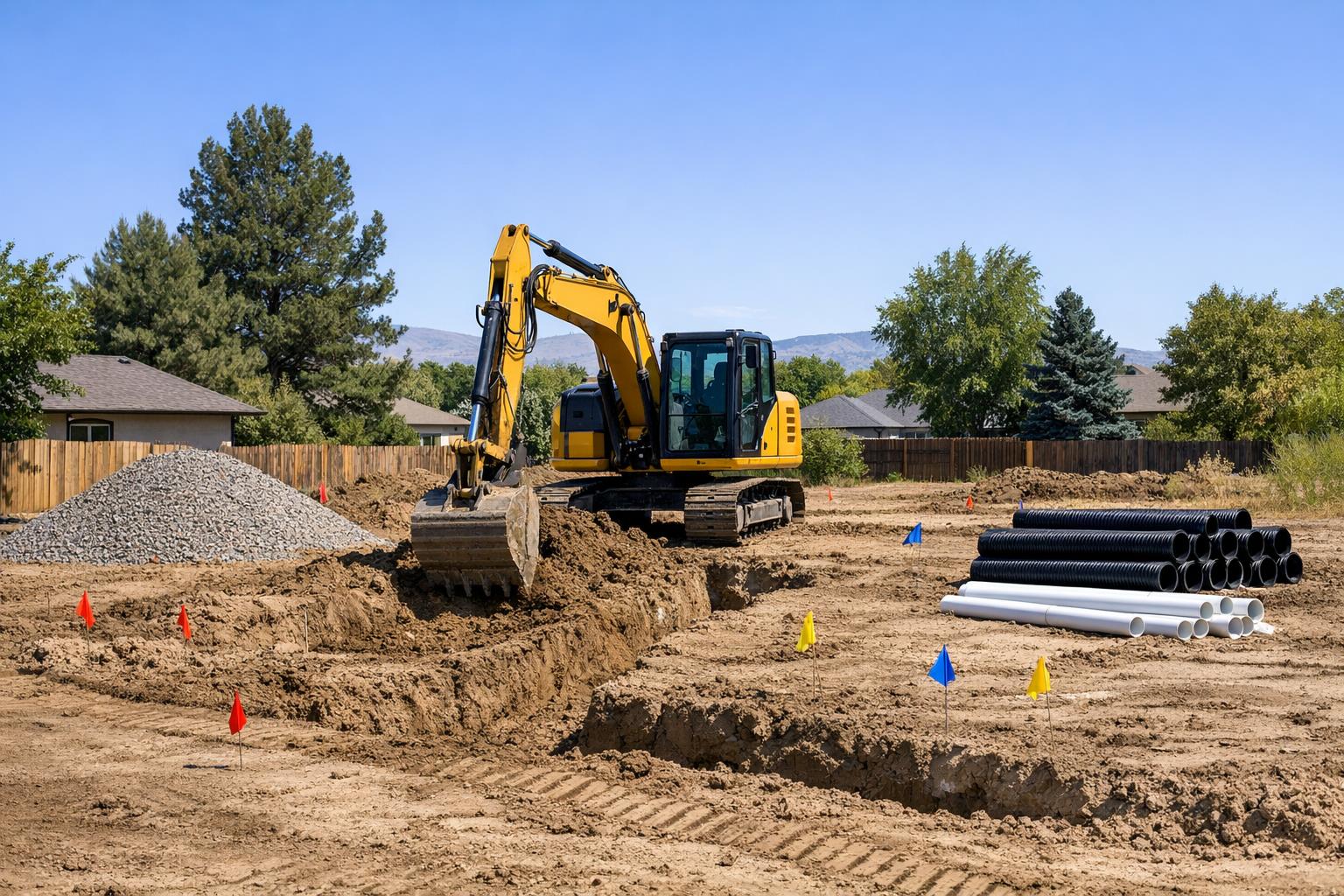
Plan it once, dig it once: what to expect from excavation and sitework in the Treasure Valley
Boise-area excavation is more than “moving dirt.” It’s the sequence of decisions and field checks that determines whether a driveway stays smooth, a slab stays level, drainage behaves in spring runoff, and utilities stay safe and code-compliant. If you’re planning a new build, a shop slab, a driveway/RV pad, a retaining wall, or a utility hookup, this guide walks through the process in plain language—so you can compare contractors confidently and avoid the common surprises that happen below grade.
What “excavation” includes (and what it doesn’t)
When people search excavation Boise ID, they’re often picturing a machine digging a hole. In practice, excavation is a coordinated scope that may include:
Site clearing & rough grading
Removing vegetation/obstructions, establishing basic slopes, and setting the site up for staking and compaction.
Foundation excavation
Digging to planned elevations for footings, stem walls, basements, or slab-on-grade preparation.
Utility trenching & bedding
Trenches for water, sewer, electrical conduit, communications, gas, or irrigation—plus appropriate bedding and backfill practices.
Drainage shaping
Swales, grading transitions, and preparation for downspout tie-ins or stormwater routing, where applicable.
What it may not include automatically: permitting fees, engineering, survey staking, imported base material, export hauling (spoils), erosion control beyond basics, or utility company fees/inspections. A solid contractor spells out what’s included and what’s a coordinated “next step.”
The 6-step site prep timeline most Boise projects follow
Here’s a homeowner-friendly sequence that helps you understand schedules and “why we can’t pour yet” moments:
1) Scope + access planning
Where equipment enters, where spoils go, what must be protected, and how neighbors/streets are affected.
2) Utility locate ticket (811)
Idaho’s damage-prevention rules require contacting the one-call service before digging. The state guidance notes contacting the service at least two business days before excavation and using white paint for pre-marking when needed.
3) Clearing + rough grade
Remove obstacles and shape the site so staking and subgrade prep can be accurate.
4) Excavation to plan elevations
Digging for footings, slabs, utilities, or retaining walls—then checking grades and slopes.
5) Subgrade conditioning + compaction
Where longevity is won: moisture conditioning, proof-rolling when appropriate, and compacting lifts.
6) Inspections/approvals + next trade handoff
Coordinate with inspectors/utilities, then hand off for forms, rebar, concrete, or installers.
Key decision points that affect performance (without talking “price”)
You don’t need a construction background to ask smart questions. These are the items that most often separate “looks good on day one” from “still performing years later”:
Base preparation under concrete
For driveways, walkways, and RV pads, the quality of sub-base and compaction matters as much as the concrete itself—especially with Boise-area freeze/thaw cycles. Ask how subgrade is evaluated, what base is recommended, and how compaction is verified.
Drainage and water routing
Many “settlement” complaints start as water problems. Confirm how surface water will move away from slabs, foundations, and retaining walls, and whether any swales or drain features are part of the plan.
Utility safety and documentation
Idaho’s excavation rules emphasize calling the one-number notification service before digging and waiting for utility responses before excavation begins. This reduces risk, downtime, and liability.
Soils, frost, and footing depth conversations
Frost depth varies by location and exposure. In nearby communities, some municipal codes specify minimum footing depths (for example, Mountain Home declares a two-foot frost depth for foundations). Your exact project should follow the applicable local code and inspection requirements for your jurisdiction.
Pro tip for comparing bids:
Ask each contractor to describe assumptions—access, spoils/export, base thickness, compaction approach, inspection coordination, and restoration. Most confusion comes from assumptions that were never written down.
Comparison table: common Boise-area projects and what to clarify upfront
| Project Type | What the excavation/sitework typically includes | Questions that prevent surprises |
|---|---|---|
| Slab or shop pad | Cut/fill, subgrade prep, base placement, forming elevations coordination. | How will base and compaction be handled? Any drainage shaping before concrete? |
| Driveway / RV pad | Demo (if replacing), grading, base, transitions to garage/street, water control. | Who handles removal/haul-off? How are edges and drainage addressed? |
| Utility trenching | Locate coordination, trenching, bedding/backfill, restoration, inspections, and planning. | Who coordinates 811 and inspection timing? How is backfill placed/compacted? |
| Septic installation | Site evaluation support, tank excavation, drainfield excavation, final grading. | Is the installer properly registered? Who manages permits and evaluation steps? |
| Retaining wall | Excavation, base prep, drainage stone and pipe planning, backfill and compaction. | How is water managed behind the wall? What is the backfill/compaction plan? |
For septic work in Southwest Idaho, Southwest District Health outlines installer registration and permitting steps, including required installer registration and an on-site evaluation prior to permit issuance.
Local Boise angle: right-of-way and highway district coordination
In Boise and across the Treasure Valley, the “edge conditions” can be the most time-sensitive part of sitework—especially when a project touches the public right-of-way (street frontage, sidewalks, approaches) or requires traffic control.
Ada County Highway District (ACHD) notes that permits are required for certain activities in the public right of way. If your driveway tie-in, utility work, or restoration area extends into public jurisdiction, confirm early who is pulling permits and who is responsible for restoration standards.
A practical way to keep schedules clean: ask your excavation contractor to identify any likely right-of-way impacts during the initial walkthrough, not after the equipment arrives.
Talk with a licensed, insured excavation contractor in Boise
If you’re planning excavation, trenching, grading, a foundation/slab, a driveway/RV pad, demolition, or a retaining wall, C3 Groundworks can help you scope the work clearly and coordinate the right sequence for your project.
FAQ: Excavation and site prep in Boise, Idaho
Do I really need to call 811 if I’m digging on my own property?
Yes. Idaho’s damage-prevention guidance indicates you should contact the one-number notification service at least two business days before excavation and wait for utility responses before digging. It’s free, and it’s a major safety step.
What should I have ready before I request an excavation estimate?
A simple sketch or marked area, your project goal (shop slab, trenching, driveway replacement, etc.), and any known constraints (access width, fencing, sprinkler lines, nearby structures). If you have plans, survey staking, or engineering notes, those help tighten the scope.
What causes settling or cracking after sitework?
Common contributors include inadequate compaction, poor base preparation, trapped water, or mismatched backfill materials around trenches. Good excavation contractors focus on subgrade prep, lift placement, and water management—not just speed.
How does septic installation differ from a standard utility trench?
Septic involves site evaluation and permitting steps, specific excavation for tanks and drainfields, and often tighter requirements around soil conditions. Southwest District Health outlines installer registration expectations and permit process details for septic and land development.
If my project touches the street or sidewalk, who handles permits?
It depends on jurisdiction and scope, but in Ada County, the highway district notes permits are required for certain activities in the public right-of-way. Clarify early whether the contractor, homeowner, or a separate party is responsible for pulling and closing out right-of-way permits.
Glossary (plain-English)
Subgrade: The native soil surface that supports base material, concrete, or asphalt.
Compaction: Densifying soil or base in layers (“lifts”) to reduce settling and improve load support.
Rough grade / final grade: Rough grade establishes general elevations; final grade fine-tunes slopes for drainage and finished surfaces.
Right-of-way (ROW): Public area typically including roadway, sidewalk, and adjacent utility corridors; work here may require permits.
811 locate ticket: A request to have participating utilities mark underground lines before excavation begins. Idaho guidance notes for contacting the one-number service prior to digging.