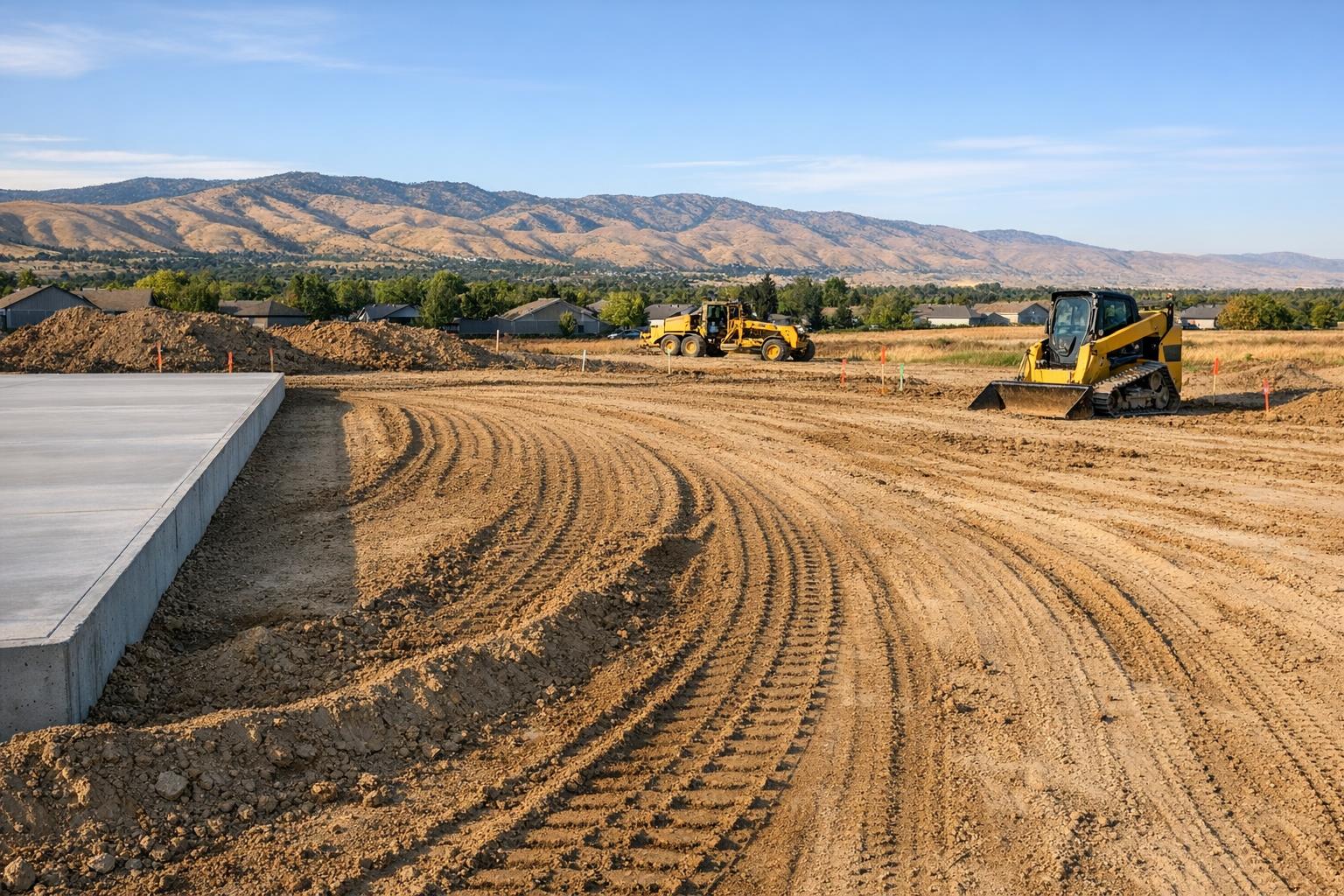
A dry foundation starts with dirt work done right
In the Treasure Valley, water problems rarely start at the roofline—they start at grade. If a lot is even slightly “back-pitched” toward a home, shop, driveway, or septic area, Boise’s spring rains, snowmelt, and irrigation cycles can turn small low spots into chronic ponding, soggy subgrades, and erosion that steals your timeline. The fix is almost always cheaper and cleaner before foundations, flatwork, and landscaping go in: correct grading for drainage.
Local focus keyword: grading for drainage Boise
What “grading for drainage” really means (and why Boise lots are tricky)
Grading for drainage is the process of shaping the ground so surface water has a clear, intentional route away from structures and toward a safe discharge point—without creating new low spots, erosion channels, or conflicts with neighbors. It’s not just “making it look flat.” It’s creating positive drainage.
Around Boise, Meridian, Kuna, Nampa, and the wider Treasure Valley, drainage challenges often come from a mix of compaction, variable soils, and hard layers (like clay lenses or caliche) that slow infiltration. That means even moderate rain or overwatering can run across the surface and collect where you least want it—near foundations, window wells, crawlspaces, driveways, and septic components.
The core goal: keep water moving away from structures
1) Establish positive slope near foundations
A common professional benchmark is building the ground so it falls away from the structure for the first several feet. Many geotechnical recommendations and local design references frequently call out a minimum fall equivalent to roughly 12 inches over 10 feet away from the foundation in typical conditions, unless a different engineered approach is used (like swales, perimeter drains, or hardscape that directs flow). The exact “right” slope depends on your finished floor elevation, setbacks, soil behavior, and where the water is allowed to go.
2) Create a defined drainage path (swales, ditches, or piped systems)
Water should have a destination: a street gutter (where permitted), an approved storm system connection, a properly graded swale to a low outfall, or a controlled on-site solution designed to avoid nuisance discharge. “Let it soak in” is not a plan when subgrades are compacted for construction.
3) Protect the subgrade you’re about to build on
If water sits on the building pad, it softens and pumps the soil under load, increases the risk of settlement, and can create rework once concrete and framing start. Smart grading keeps the pad area “build-ready,” not just “roughly flat.”
Quick “Did you know?” facts for Boise-area projects
Did you know: For many construction sites, disturbing 1 acre or more typically triggers stormwater permitting requirements under Idaho’s construction general permit program, and requires inspections by knowledgeable personnel.
Did you know: Boise has city standards that address erosion, sediment, and fugitive dust control—meaning “just grade it and leave it” can create compliance issues if sediment moves off-site.
Did you know: ADA-related cross-slope limits (commonly around 2% max on accessible routes) can impact how you shape walkways and flatwork—drainage and accessibility should be planned together.
Common drainage grading approaches (and where each one fits)
| Approach | Best for | Watch-outs |
|---|---|---|
| Regrade to positive slope away from structures | New builds, pad prep, fixing minor negative slope | Must preserve required elevations (FFE), avoid pushing water to neighbors |
| Swales / shallow ditches | Rural lots, acreage, perimeter drainage, long runs | Erosion control is critical; needs a stable outfall |
| Area drains / catch basins with solid pipe | Courtyards, driveways, tight side yards, low spots you can’t regrade | Requires a lawful discharge point; maintenance access matters |
| Retaining + terrace grading | Sloped sites, grade changes, usable yard creation | Needs drainage behind wall; engineering may be required |
| Subgrade improvement + compaction control | Soft pads, wet seasons, heavy loads (shops, RV pads) | Timing and moisture conditioning matter; avoid building on frozen/overly wet soils |
Budget note for Boise-area owners and builders: the biggest “money saver” in grading isn’t cutting corners—it’s reducing import/export. A thoughtful cut/fill plan and correct compaction can prevent paying twice: once to move dirt, and again to fix drainage after concrete or landscaping is installed.
A practical grading checklist before foundations, slabs, or flatwork
- Confirm elevations: finished floor elevation (FFE), driveway tie-ins, garage/door thresholds, and any required freeboard.
- Locate utilities early: trenching and hookups (water, sewer, power, gas, telecom) can change grades and drainage paths—plan the sequence so trenches don’t become unintended channels.
- Plan where water goes: swale, storm line, or other approved outfall. “Away from the house” is only half the answer.
- Shape the pad and transitions: avoid “micro-bowls” near corners, downspout locations, window wells, and walkouts.
- Protect the work: install erosion and sediment controls appropriate to the site (and any permit requirements) before major storms, not after rills appear.
- Set compaction expectations: especially for driveways, RV pads, shop slabs, and retaining wall backfill—subbase and moisture conditioning matter in freeze-thaw environments.
If your schedule targets spring starts, consider that early-season moisture can be the hidden constraint: grading at the right moisture content helps you achieve compaction and reduces later settling. Rushing wet soils often leads to pumping, rutting, and rework once trucks and concrete arrive.
Boise & Treasure Valley local angle: permitting, dust, and stormwater compliance
For developers and rural landowners preparing lots, drainage is tied directly to compliance. Idaho DEQ’s stormwater program typically requires coverage when construction disturbs 1 acre or more, and the permit framework expects erosion and sediment controls plus inspections. Boise also has standards that address erosion, sediment, and fugitive dust control—important for grading and demolition phases where soils are exposed.
Practical takeaway: when you plan grading for drainage, include your erosion control plan and construction sequence in the same conversation. A well-shaped swale that isn’t stabilized can turn into a sediment highway in one storm. A clean pad that isn’t protected can crust, rut, and shed water in the wrong direction.
Pro tip for builders: If you need accessible routes, coordinate drainage slopes with ADA cross-slope limits early—this helps avoid last-minute changes to walkways and flatwork that can accidentally redirect water back toward the structure.
Pro tip for rural properties: Swales and ditches work extremely well when they have a stable outlet and erosion protection. If you’re balancing a lot, aim to “design the water’s path” the same way you’d design a driveway approach—intentional, smooth, and durable.
Ready for a build-ready pad and a clear drainage plan?
C3 Groundworks is a locally owned, licensed, bonded, and insured excavation and site-prep contractor serving Boise and the Treasure Valley. If you’re clearing land, correcting drainage, trenching utilities, installing septic, or preparing a foundation pad, a quick site conversation can prevent months of water headaches later.
Want to see examples of finished pads, grading, and flatwork? Visit our project gallery.
FAQ: Grading for drainage in Boise
How do I know if my lot has a grading problem?
Common signs include standing water within 24–48 hours after rain/irrigation, erosion rills on bare soil, wet crawlspace odors, water collecting near corners of a foundation, or driveway edges that trap runoff and send it toward the building.
Is adding topsoil enough to fix drainage?
Sometimes it helps visually, but topsoil alone often settles and can hide a low spot instead of fixing it. Drainage correction usually needs shaping, compaction control, and a defined outlet path for water.
Can I grade water “to the fence line” and call it good?
It’s risky. Pushing runoff to property lines can create neighbor conflicts and may violate local requirements depending on the situation. The best plan routes water to an approved discharge point or an engineered on-site solution that doesn’t create a nuisance.
Do I need a SWPPP or erosion control plan for lot grading near Boise?
If your project disturbs large areas (often 1 acre or more), stormwater permit coverage and a SWPPP are commonly required in Idaho. Even smaller projects may need erosion, sediment, and dust controls depending on location and scope. It’s smart to verify early—before equipment mobilizes.
How does grading interact with septic system installation?
Septic drainfields need appropriate separation from seasonal wet conditions and should not become the “lowest point” where runoff concentrates. Coordinating grading, downspouts, swales, and driveway runoff helps protect long-term septic performance.
What services usually pair well with drainage grading?
In Boise-area builds, drainage grading often pairs with excavation, utility trenching, lot development, and retaining wall construction when the site has meaningful elevation changes.
Have a specific situation (negative slope backyard, wet pad, or drainage crossing a driveway)? Contact C3 Groundworks and share a few photos and a simple sketch—getting the drainage “map” right early saves time later. Contact us
Glossary
Positive drainage: Ground shaped so water flows away from buildings and toward a planned outlet, not into low spots.
Swale: A shallow, wide channel that gently conveys runoff across a property without creating erosion.
Subgrade: The prepared soil layer under slabs, driveways, and base rock—its stability affects settlement and cracking.
Cut and fill: Earthmoving balance where soil is removed from high areas (cut) and placed in low areas (fill) to reach design elevations.
SWPPP: Stormwater Pollution Prevention Plan—documents and practices used to prevent sediment and pollutants from leaving a construction site where permit coverage applies.
Learn more about C3 Groundworks’ team and approach on our About page, or browse services on Our Services.