What “simple trenching” really involves in the Treasure Valley
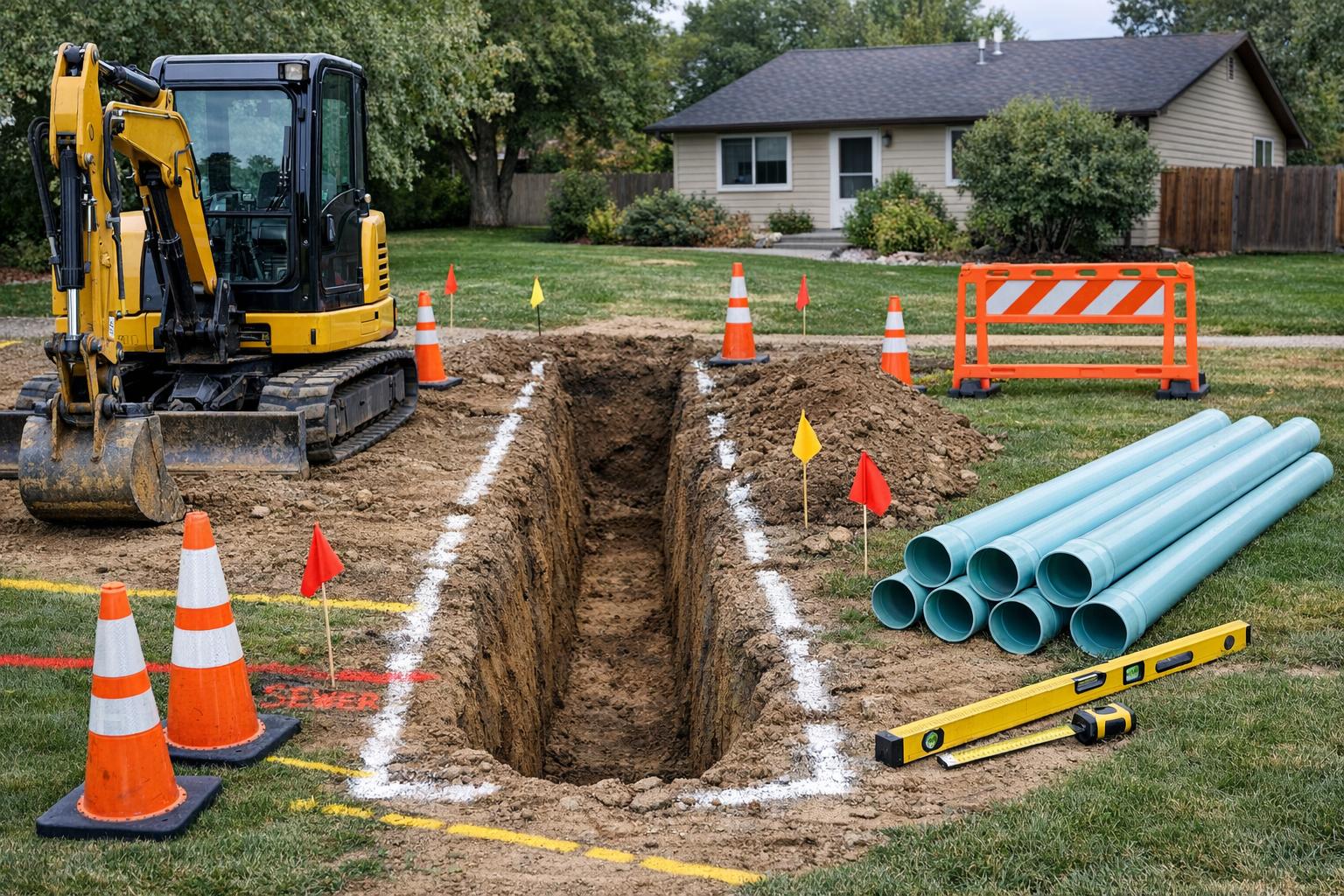
Sewer line excavation in Boise is one of those jobs that looks straightforward until you’re coordinating 811 locates, trying to keep proper fall to the main, protecting nearby utilities, and passing inspection without rework. Whether you’re a homeowner adding a shop/ADU or a plumber or small GC lining up a side sewer connection, good trenching is about more than digging a line—it’s about safety, grade control, bedding/backfill, and a clean paper trail so the rest of the project stays on schedule.
Primary keyword focus
If you’ve been searching for sewer line excavation Boise, this guide walks through the practical steps that help avoid delays and protect your property: pre-marking, safe digging, trench stability, grade checks, and inspection readiness.
Who this is for
Homeowners installing shops, ADUs, or new service lines—and trades (plumbers, electricians) and small GCs who need trench work coordinated cleanly with hookups and inspections.
Step-by-step: what a sewer excavation plan should cover
1) Confirm scope: repair, replacement, or new connection.
A trench for a new shop tie-in is different from a spot repair. Before equipment shows up, clarify: pipe size/material, tie-in location (city main vs. private septic), cleanout placement, and whether other utilities are going in the same corridor.
A trench for a new shop tie-in is different from a spot repair. Before equipment shows up, clarify: pipe size/material, tie-in location (city main vs. private septic), cleanout placement, and whether other utilities are going in the same corridor.
2) Utility locating and site pre-marking.
In Idaho, 811 is free and intended to prevent strikes. Best practice is to call at least two business days before digging, then keep markings visible and re-locate if conditions change. Many excavation rules also encourage white-lining (pre-marking) the planned dig path so locators know exactly what to mark.
In Idaho, 811 is free and intended to prevent strikes. Best practice is to call at least two business days before digging, then keep markings visible and re-locate if conditions change. Many excavation rules also encourage white-lining (pre-marking) the planned dig path so locators know exactly what to mark.
3) Permitting and inspection choreography.
Sewer work commonly triggers permits/inspections (and sometimes coordination with the city or district). The trench typically can’t be backfilled until required inspections are complete. A good sequencing plan prevents “open trench downtime” that stalls concrete, framing, or landscaping.
Sewer work commonly triggers permits/inspections (and sometimes coordination with the city or district). The trench typically can’t be backfilled until required inspections are complete. A good sequencing plan prevents “open trench downtime” that stalls concrete, framing, or landscaping.
4) Grade control (the make-or-break detail).
Gravity sewer needs a consistent slope (fall) without bellies. Many jurisdictions use slope rules like 1/4″ per foot for 4″ sewer as a minimum standard for laterals/service connections. Even when your local inspector allows alternatives, the principle stays the same: keep a steady fall, confirm with laser/level, and document as needed.
Gravity sewer needs a consistent slope (fall) without bellies. Many jurisdictions use slope rules like 1/4″ per foot for 4″ sewer as a minimum standard for laterals/service connections. Even when your local inspector allows alternatives, the principle stays the same: keep a steady fall, confirm with laser/level, and document as needed.
5) Bedding, haunching, and backfill—not just “throw dirt back in.”
Proper bedding helps protect the pipe and maintain grade. Controlled lifts and compaction reduce future settlement that can create dips, cracking, or yard sinkholes—especially important under driveways, RV pads, and slabs.
Proper bedding helps protect the pipe and maintain grade. Controlled lifts and compaction reduce future settlement that can create dips, cracking, or yard sinkholes—especially important under driveways, RV pads, and slabs.
6) Restore surfaces and protect drainage patterns.
If the trench crosses a driveway, sidewalk, or landscaped area, restoration planning matters. Done right, you avoid trip hazards, ponding water, and patchwork that looks out of place.
If the trench crosses a driveway, sidewalk, or landscaped area, restoration planning matters. Done right, you avoid trip hazards, ponding water, and patchwork that looks out of place.
Sub-topic: safety and “soft digging” around existing lines
In older Boise neighborhoods and rural edges of the Treasure Valley, it’s common to find undocumented irrigation lines, private power feeds, or abandoned piping. Even after 811 marks, careful excavation practices matter:
Smart jobsite habits that prevent strikes:
• Keep the trench alignment tight to the plan (avoid “wandering” into unknown areas).
• Use cautious exposure methods when approaching marks (hand tools or vacuum excavation where appropriate).
• Treat “unmarked” as “unknown,” especially on private property where owner-installed lines exist.
• Use cautious exposure methods when approaching marks (hand tools or vacuum excavation where appropriate).
• Treat “unmarked” as “unknown,” especially on private property where owner-installed lines exist.
Did you know? Quick Boise-area trenching facts
811 timing matters
Idaho utilities recommend calling at least two business days before you dig, even for “small” projects like posts or landscaping.
Pre-marking can reduce confusion
Idaho damage-prevention guidance references pre-marking the excavation route (often with white paint/flags) so locators and crews stay aligned.
Slope is a real inspection issue
Many local codes specify minimum slope requirements (often cited as 1/4″ per foot for 4″ sewer service laterals) to keep gravity flow moving.
Comparison table: common trenching approaches (and when they fit)
| Approach | Best for | Watch-outs | Schedule risk |
|---|---|---|---|
| Open-cut trench (traditional) | Most residential sewer replacements, new laterals, shop/ADU tie-ins | Surface restoration; grade control; utility conflicts | Medium (inspection timing + backfill) |
| Spot excavation (targeted repair) | Localized break/collapse confirmed by camera or cleanout access | Hard to hit the exact location without good diagnostics | Medium–High (if the defect extends beyond the spot) |
| Utility corridor trench (multi-line) | Coordinating sewer + water + electrical conduit to a new structure | Clearance rules; staged inspections; different depth requirements | High (multiple trades + approvals) |
Note: Specific methods depend on site conditions, utility density, local inspection requirements, and the rest of your build schedule.
Boise/Treasure Valley angle: grade, frost, and seasonal planning
Boise projects tend to share a few planning realities:
Freeze–thaw and burial depths: While sewer laterals aren’t “freeze protected” the same way pressurized water lines are, Boise-area builders still think in terms of frost exposure and winter access. Practical guidance sources often place Treasure Valley frost depths in roughly the 24–36 inch range (site-dependent). Confirm depth expectations with your local building department and your specific plans.
Seasonal scheduling: Wet shoulder seasons can complicate compaction and make cleanup harder. If your project timeline includes concrete (slabs, driveways, RV pads), coordinating trenching first—then proof-rolling/compaction—helps reduce cracking and settlement later.
Tight sites and existing landscaping: Many Boise lots have mature trees, irrigation, and established grades that need to stay intact. A contractor who plans spoils staging, access routes, and restoration up front can save days of rework.
Helpful next steps on the C3 Groundworks site
If you’re coordinating trenching alongside other work, these pages can help you map the sequence:
Utility Trenching (planning, alignment, and safe execution)
Sewer & Water Hookups (coordinating trench-to-connection work)
Excavation Services (broader site prep and excavation support)
Site Clearing & Grading (drainage, pad prep, and finish grading)
Sewer & Water Hookups (coordinating trench-to-connection work)
Excavation Services (broader site prep and excavation support)
Site Clearing & Grading (drainage, pad prep, and finish grading)
Need sewer line excavation coordinated with trenching & hookups?
C3 Groundworks supports homeowners and small GCs across Boise and the Treasure Valley with safety-first excavation, clean grade control, and jobsite communication that keeps other trades moving.
Request a Site Walk & Trench Plan
Prefer to browse work first? Visit the project gallery.
FAQ: Sewer line excavation in Boise
Do I really need to call 811 if I’m hiring a contractor?
The excavator is responsible for making sure a locate request is made, and it’s smart for owners to confirm it’s done (with the ticket/reference number). Idaho guidance also emphasizes waiting the full two-business-day window.
What causes a sewer trench to fail inspection?
Common issues include improper slope, poor bedding, damaged pipe, missing cleanouts, or backfilling before the inspection. Grade control is one of the biggest: inspectors don’t want bellies or inconsistent fall that can trap solids.
How deep does a sewer line need to be in Boise?
Depth depends on tie-in elevation, required slope to the main, crossings with other utilities, and local inspection expectations. For water services, frost depth often influences burial depth; practical guidance places Boise/Treasure Valley frost depths roughly around 24–36 inches, but your site can vary. Always confirm with the local authority having jurisdiction and the approved plans.
Can sewer and water share the same trench?
Sometimes, but only if your local code/inspector allows the configuration and the required separations are met. Many crews choose separate trenches to simplify approvals and reduce the risk of cross-contamination or rework when one line needs future service.
Should I expect pricing to vary a lot for sewer excavation in the Boise area?
Yes—conditions drive the range. Factors like depth, access (tight side yards vs. open lots), surface restoration (concrete/asphalt/landscaping), soil and groundwater, and utility congestion can change the equipment and time required. A detailed site walk and a clear trench plan typically produce the most predictable outcome.
For more general questions about services and processes, you can also visit C3 Groundworks FAQs.
Glossary (quick, plain-English)
811 / One-Call
A free service that notifies participating utility owners to mark underground facilities before excavation.
White-lining
Pre-marking the planned excavation path (often in white paint/flags) so locators and crews agree on the dig corridor.
Grade / Slope / Fall
The intentional downward pitch of a gravity sewer line to keep flow moving toward the main.
Bedding & haunching
Engineered material is placed under and around the pipe to support it evenly and reduce settlement.
Belly
A low spot in the pipe where water/sediment can collect—often caused by poor compaction or grade control.